Feeds:
Posts
Comments

Archive for the ‘Jim Ehrhard’ Category

Anyone who visits my office is always amazed at the number of books that I have on my shelves (I have even more stored away!). I’m often asked, “Have you read all of these?” To which I can honestly reply, “Yes, most of them.”

I love to read and I have collected many excellent resources to help me in my teaching and preaching. But I know that many pastors, missionaries and laymen cannot have anywhere near the library that I’ve been blessed with. Some can barely afford to have more than a couple of resources besides their Bibles.

ONE RESOURCE TO HAVE. . .

Of all the resources I have, the one that has been the greatest blessing to my personal life and my teaching ministry has been Matthew Henry’s Commentary on the Whole Bible (MHC). It is devotional, expositional and provides a good solid theological commentary on every passage in the Bible. Matthew Henry is also full of great wit, practical illustrations and short, memorable quotations. No other single resource can provide you with so much.

MHC comes in two basic formats: (1) a one volume version that excludes the scripture passages, and (2) a six volume set that includes the scripture and has larger print. I have both. I tried to save money by buying the one volume. After purchasing the six volume version, I would recommend that you spend the extra $10.00 — $20.00 and get the six volumes. It is more usable with the scripture right in the text and far more readable due to the larger text.

USING MATTHEW HENRY

Most who purchase MHC use it simply as a commentary on a particular passage. While I always consult MHC when teaching, I find it more helpful when used devotionally. Let me give you an example of how I have used MHC.

Let’s say you were planning to preach from 1 Kings. I would study through 1 Kings devotionally before I ever begin the series. I usually work through one paragraph a day rather than a chapter. (This is another advantage to the six volume set — it is set in paragraph sections. The one volume treats a chapter at a time.) I read the passage through making my own observations and notes.

Then I proceed to Matthew Henry’s Commentary and do the following:

(1) Using 3-4 different colored pencils (markers bleed through the pages), I highlight his outline to overview his thoughts.

(2) I begin by using a red pencil to mark major headings (usually I, II, III, etc.) through the entire section. This gives me a clear view of where he is going. This is very helpful. Because of the way the MHC is formatted, it is very easy to be lost trying to find when he changes ideas and thoughts.

(3) I return to each section and read the section highlighting the next outline level with green (usually 1, 2, 3, etc.) and the next with orange [(1), (2), (3), etc.] I reserve the yellow for key quotes or ideas.

(4) Next, I make notes on that section using an outline similar to his but using my own words. I include key quotes that I want to remember and add ideas, illustrations or verses of my own that may be relevant.

(5) Then, I move on to the next section and follow the same pattern.

(6) When I have finished the entire paragraph, I end by re-reading the passage and summarizing what God is saying to me from the passage and notes under a section called “My Response.” Then I close by praying about what God has said through the passage.

When finished, I have the following:

(1) a set of outline notes on the passage;

(2) quotes, verses and ideas about the passage for future use; and

(3) a Biblical, theological devotion that has impacted my own life.

These notes I file either by topic or according to the text (e.g. 1 Kings 3). When I am ready to teach the passage, I have already surveyed the passage, taken some notes and been personally touched by its application to my life. This gives me a very good beginning for a message or Bible study.

Copyright Jim Ehrhard, 1999. You are permitted to reproduce and distribute this material in any format provided that: (1) you credit the author; (2) any modifications are clearly marked; (3) you do not charge a fee beyond the cost of reproduction; and (4) you do not make more than 100 copies without permission. If you would like to post this material to your web site or make any use other than as defined above, please contact Teaching Resources International

Read Full Post »

Assurance of Salvation by Jim Ehrhard

When we come to the doctrine of assurance, there is often much misunderstanding. Many do not have assurance because they have been taught that such assurance is not possible. On the basis of passages taken out of context, they have concluded that all believers have the potential to lose their salvation. On the other hand, many who believe in the “security of the believer” often do so on the basis of a faulty, man-centered theology of salvation. This series of articles attempts to address these problems through an examination of the Scriptures. Since there are many passages to examine, I ask that you be patient and prayerful as you read this series. My hope is that many will find that their only assurance is in Jesus Christ alone.

The doctrine of assurance is not something to take lightly. D. Martin Lloyd-Jones states: “Nothing is more important for us than to know that we are indeed the children of God…. You can’t really enjoy the blessings of the Christian life unless you’ve got this assurance.” John MacArthur, Jr. agrees: “No doctrine is more immediately practical than the doctrine of assurance.” If you have no assurance of God’s acceptance, you have no peace. If you have no peace, you will lose your joy. If you have no joy, your testimony will lose its radiance.

Much is really at stake when we consider the issue of assurance. First, your prayer life will be hindered by a lack of assurance. How can you be confident in your praying if you are not even sure you are a child of God? And how can one “come boldly before the throne” while the possibility of judgment still looms. Second, your perseverance in trials will be affected by a lack of assurance. In Romans 8:18, Paul expresses the motive that kept him going in all kinds of trials and hardships: “For I reckon that the sufferings of this present age are not worthy to be compared to the glory to be revealed in us.” But how can one keep on if unsure that any “glory” awaits in heaven?

Third, your service for the Lord will be affected by a lack of assurance. Hebrews 6:10 tells us: “God is not unjust to forget your labor and work of love….” But if you are not sure you will even make heaven to gain His reward, why serve the Lord in this life? Thomas Manton suggests that, when believers are unsure about their salvation, they “serve the Lord in fits and starts.” Fourth, your confidence at death will be shaken without assurance of salvation. In I Corinthians 15, Paul explains that he was willing to “fight the wild beasts of Ephesus” only because he was confident of his own hope of eternal life based on the reality of Jesus’ resurrection. Indeed, would any give their life for the sake of Christ if death might mean entrance into eternal damnation? No, only with the certainty of eternal life settled could any say, “For me to live is Christ and to die is gain.”

Fifth, assurance affects your zeal in evangelism. Someone has defined evangelism as “one beggar telling another beggar where to find bread.” Evangelism is one satisfied customer telling another about the great gift he has received. But if you’re not sure you that gift is really yours forever, how can you be excited about sharing it with others?

Most important as we study this doctrine is to know what the Bible says about assurance. A study of the Scriptures on assurance leads to three conclusions. (We will look at problem passages in later studies.)

1. Many who have assurance are not saved. It is most important that we begin any study of assurance with this warning. As an old spiritual says, “Everybody talkin’ bout heaven ain’t goin’ there.” In fact, a recent survey discovered that 99% of Americans believe that they are going to heaven! According to Jesus, “Many will say to me, ‘Lord, Lord,’ and I will say, ‘I never knew you.’”

Many are falsely assured because they think that belonging to the right religious group will get them into heaven. John the Baptist warned the Pharisees, “God can raise up son to Abraham from stones.” Others are falsely assured because they have watered down the Bible’s view of God and His judgment of sin. They reason that “God loves everyone and wouldn’t send anyone to hell,” or they believe that God only punished certain “serious” sins. Still others believe that they will get to heaven because they have lived a pretty good life. But the Bible teaches that all these are falsely assured. As one author puts it, “The only thing worse that NO ASSURANCE is FALSE ASSURANCE.”

2. Some who are saved do not have assurance. Many of these lack assurance because of misunderstandings that they have been taught about salvation and assurance. For example, some suggest that you are not a Christian if you do not know the date you were saved. They explain that you know your birthday, so you ought to know your spiritual birthday. But such reasoning is not logical. You only know your birthday because you were told it repeatedly as a child. Knowing your birthday is not evidence you are alive–signs of life are. Many who are born again cannot tell the exact day of their spiritual birth but they are clearly spiritually alive.

Others suggest that you are not a Christian if you have doubts about your salvation. I John 5:13 makes it clear that true believers can have doubts. In fact, John says he writes to help believers know for sure that they have eternal life. Even the great Charles Spurgeon entertained doubts. He said, “I have only known one or two saints who have rarely doubted their interest in Christ at all.” There are many reasons for such doubts such as unrepentant sin, spiritual laziness, demonic attacks, physical and mental problems, comparisons with the experiences of other believers, and childhood conversions. (We may look at some of these reasons in a future article.)

Some suggest that you are not a Christian if you didn’t pray “the prayer.” Such is a false view of salvation. Nowhere in the New Testament are we told that one must “pray a prayer” to be converted; we certainly are never given a specific one to pray. In reality, one must “call upon the Lord” to be saved, but to assert that a particular prayer must be prayed is not Biblical.

In brief, one can be saved though they may have doubts. Only through a Scriptural examination can one gain that assurance.

3. It is possible to have full assurance of salvation. Many passages indicate the possibility that one can be sure of their salvation. Read Romans 8:16; 2 Timothy 1:12; I John 5:13; 1 Peter 1:4-5; Jude 24 and 2 Peter 1:10. The passage in 2 Peter is especially interesting since there we are told to “make our calling and election sure.” In other words, even though the matter is settled from God’s perspective, we may not be sure. Thus Peter gives some instructions to help lead to assurance. (We will look at this passage in a future article.)

After reading all of this, may I ask you one question? Are you concerned about your assurance? One test of real faith is concern about your spiritual life and destiny. Charles Spurgeon once said that if you are concerned about your election, you probably are elect. Those truly converted care about spiritual things.

Interestingly, the converse is also true. Spurgeon also noted that it did not surprise him that some doubted their conversion. What surprised him was that one who lacked assurance of his eternal destiny could rest one minute until he had settled that question. One modern author, Donald Whitney, likens such a one to a person on the brink of bankruptcy hearing from his attorney that he might be heir to a fortune. Would that person not do everything in his power to find out for sure about that inheritance? Yet I have talked with many who expressed doubts about their salvation who were not slightly interested in doing anything to find out for sure. Such is usually an indication that that person has reason to fear his eternal destiny though he may “feel” sure of heaven.

Finally, some who may read this may say, “Why check it out? I’m okay.” First, you need to check because the Scriptures tell us to: “Examine yourself to see if you are in the faith” Paul told the Corinthians. Those who are really converted have nothing to fear by an honest, Biblical examination of their salvation. Only the man-selling fake gold has anything to fear when a prospective buyer wants to have the gold tested before buying. Remember, the only thing worse than no assurance is a false assurance. What could be worse than to spend your whole life thinking that you were on your way to heaven, only to arrive at the judgment and hear Jesus say, “Depart from me, for I never knew you”? The matter of eternity is too important to go though this life unsure of your ultimate outcome.

In future articles, we will attempt to look at a number of issues related to the assurance of salvation. We intend to examine the theology of assurance, signs of assurance and various passages that are often used to question the certainty of salvation. It is our hope that these articles provide encouragement to believers and an opportunity for all to honestly examine themselves to “see whether or not they are in the faith” (2 Cor. 13:5).

Copyright Jim Ehrhard, 1999. You are permitted to reproduce and distribute this material in any format provided that: (1) you credit the author; (2) any modifications are clearly marked; (3) you do not charge a fee beyond the cost of reproduction; and (4) you do not make more than 100 copies without permission. If you would like to post this material to your web site or make any use other than as defined above, please contact Teaching Resources International

Read Full Post »

Whenever you begin to study the gospels, the question of why we have four gospels always arises. As John implies at the end of his gospel, no one book could contain all the things that Jesus did and said (John 21:25). That is the obvious answer. But we may advance three additional reasons for these four accounts.

First, they are a testimony to the accuracy of the records. With four separate accounts, we should expect 4 very different gospels with many contradictions and inaccuracies. This is even more true if, as the liberals purport, these gospels were merely the testimony of the church and not a historical account of Jesus. But instead of massive differences and contradictions, we find 4 records that, though different in style and selection, form a remarkably accurate record.

On the other hand, if the four writers wrote in collusion, we should expect their accounts to be identical. In such a case, 4 gospels that were the same should cause us to be suspect of the writers. Their differences indicate that they wrote independently yet paint the same basic picture of Jesus, His teachings and His deeds.

Matthew Henry reminds us that we do not count multiple witnesses in a court to be “tedious but necessary” to establish accuracy. Thus the four gospels do the same; they provide a multiple testimony to establish accuracy.

Second, the four provide a testimony to the completeness of the picture of Jesus. While we certainly cannot claim to have a record of all that Jesus taught and said (John 21:25), the four gospels provide us with a more complete picture of Jesus, His mission and His teachings than any one gospel could.

One might say that no one photograph would be enough. Would any parent be pleased to have only one photograph of his child? Or would that parent be satisfied in cutting up a variety of pictures of that child and pasting them together to form one? No. In the same way, we are blessed to have the four pictures instead of one composite.

Or consider the following. There have been many books written about Teddy Roosevelt. One deals with his private and domestic life. Another writes about his political life. A third focuses on his military career while a fourth deals with his life as sportsman. In every biography, we would find many common elements. Some events, all would include. But each author would include and exclude other events depending on how they fit with the purpose of the author.

In the same way, each of the gospels contains common accounts. But likewise, each provides accounts and perspectives that the others do not emphasize or include. Together, they give us a more complete picture of the life and teachings of Jesus.

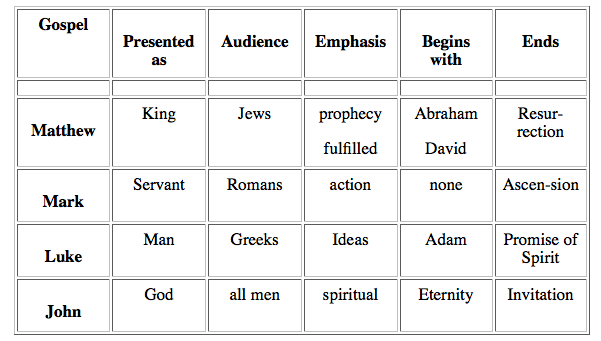
Finally, the four gospels provide four portraits for different audiences. Matthew writes primarily for the Jews. Hence his gospel is full of references to fulfilled prophecies. Mark appeals to his Roman audience by his emphasis on action and servanthood. Luke writes to the Greeks and presents aspects of the life and teachings of Jesus that as the perfect man. John writes for all mean to present the spiritual aspects of the gospel.

Here is a chart that may help put the gospels in perspective.

Copyright Jim Ehrhard, 1999. You are permitted to reproduce and distribute this material in any format provided that: (1) you credit the author; (2) any modifications are clearly marked; (3) you do not charge a fee beyond the cost of reproduction; and (4) you do not make more than 100 copies without permission. If you would like to post this material to your web site or make any use other than as defined above, please contact Teaching Resources International

Read Full Post »

When we speak of the gospel, we usually think of it in two different ways. First, we use the word gospel to refer to a document that records the life of Jesus. Hence we have the four gospels: Matthew, Mark, Luke and John. Each one provides a record of the life and teachings of Jesus. Each is called a “gospel.”

Second, we also speak of the gospel as the message about Jesus that we must share and others are called to believe. The gospel message is summarized for us by the apostle Paul in I Corinthians 15:1-8. In short, the gospel is the message of redemption provided through the death and resurrection of Jesus Christ.

Both are accurate. The gospel is a message. But it is a message rooted and grounded in the historical reality of the life, teachings, death and resurrection of Jesus Christ. In opposition to neo-orthodoxy, evangelicals must say, “If the message is not true, then it is not worth believing.” Indeed, if the record about Jesus cannot be trusted, then, in the words of Paul, “our faith is in vain” and “we of all men are to be most pitied.” Here is one area where Christianity departs from all other religions: it must be based upon truth and based upon history.

Hence, the gospel is both a record to trust and a message to share. In this article, we will examine both aspects of the gospel as an introduction to our study of the Gospel of Mark.

The Gospel: A Record of His Life

Mark 1:1 begins, “The beginning of the gospel of Jesus Christ, the Son of God. As it is written….” Above all else, the gospel is about Jesus. It is the record of His life and teachings.

Mark begins his gospel with a connection to the Old Testament. Since he writes primarily for a Roman audience, he rarely uses the expression, “It is written.” But, in verse 2, he makes clear the connection between the coming of Jesus and the Old Testament. It is a connection that must not be neglected.

In the OT, we have the prophecy of His coming; in the NT, we have the history of His coming. The Old carries the expectation of hope; the New, the experience of reality. In Job 42, Job responds to God’s revelation, “I had heard of you by the ear, but now my eyes have seen.” The OT is the “hearing” of Messiah; the NT is the “seeing.” The gospel does not begin in the NT; it begins in the prophecies of the Old: “as it is written.”

Mark not only begins his gospel by tying it to the OT, he clearly states who Jesus is: “the Son of God.” More than anything else, the gospel is the record of who Jesus is. Here, Mark pulls no punches with his readers. Though this message is offensive to the Jews and foolish to the Romans, Mark knows that any gospel that does not proclaim who Jesus is is no gospel at all.

Throughout his gospel, Mark makes clear the reality of who Jesus is. One reading Mark’s gospel could not mistake Jesus for a mere man. Jesus calms the sea, casts out demons, raises the dead and walks on the water. Yet chapter 2 makes clear that this Jesus is God who alone can forgive sins. Such is the testimony of the gospel. It rests on who Jesus is. Mark boldly proclaims: “Jesus, the Son of God.”

The Gospel: A Message to Share (Mark 1:15)

The gospel is not merely a historical document; it is a message to share and believe. Jesus began His ministry with the emphasis on the gospel. “The kingdom of God is at hand. Repent and believe the gospel” was His message.

The gospel begins, not with good news, but with bad news. It first includes the command to repent. Many today would like to present the gospel without this element of repentance. But Jesus began His ministry with such a call. Matt. 4:17 indicates that it remained His message, “From that time, Jesus began to preach and say, ‘Repent….’” He even described the purpose of His coming as to “call sinners to repentance” (Luke 5:31). He told the multitudes, “Unless you repent, you will likewise perish” (Luke 13:3,5). He even commissioned His disciples saying, “that repentance … should be preached in His name….” (Luke 24:47).

The gospel is a call to repentance. It is a call to “change our minds” about ourselves and God. It is a call to fully acknowledge our sinfulness and desperate need for God. Ralph Kuiper puts it poignantly: “Only he who is oppressed by sin will realize his need of the Saviour. Only he who knows himself to be guilty and foul will run to Calvary for pardon and cleansing” (God Centered Evangelism, p. 153).

The gospel is also a call to “believe” or “put your complete trust in Christ and His atonement.” “The heart of the gospel…. is the glad tidings of what God in Christ has done for the salvation of sinners” (Kuiper, pp. 154-55). The gospel is not “do” but “done.” While all other religions focus on what must be done by the individual to merit salvation, Christianity focuses on what Jesus has done.

The gospel is the message that Jesus paid it all. It is not the message that Jesus died to make salvation possible; He died to purchase our salvation full and free. Our only response is to “repent and believe the gospel.”

One reality now faces us as we read the opening of Mark’s gospel. It is expressed in two phrases. First, Jesus notes: “the time is fulfilled.” In Galatians 4:4, Paul tells us: “in the fulness of time, God brought forth His Son born of a woman.” In Acts 17:30, Paul explains, “Truly, these times of ignorance God overlooked, but now commands all men everywhere to repent.” In short, Jesus is proclaiming that He is the fulfillment of the prophecies and that there no longer remains any excuse for waiting. Now God commands us to repent and believe the gospel. Second, Jesus points out “the Kingdom of God is at hand.” Again the message is clear: the time for waiting is over. Messiah has come. How will you respond?

By Jim Ehrhard

Copyright Jim Ehrhard, 1999. You are permitted to reproduce and distribute this material in any format provided that: (1) you credit the author; (2) any modifications are clearly marked; (3) you do not charge a fee beyond the cost of reproduction; and (4) you do not make more than 100 copies without permission. If you would like to post this material to your web site or make any use other than as defined above, please contact Teaching Resources International

Read Full Post »

A Theological Response to Terrorism by Jim Ehrhard

Events like those that we witnessed on September 11, 2001 in the destruction of the World Trade Center Towers in New York can raise a number of important theological issues for believers.  It is important that we not make wrong conclusions about events like these, but biblical conclusions that will result in biblical actions and attitudes.

In considering these, we must first recognize that, in spite of how terrible this event was, it is not the most tragic event in human history.  In fact, many of the events in the Bible were equally significant and devastating to the people of Israel.  One example would be the destruction of Jerusalem by Nebuchadnezzer in 586 B.C.  In that event, the entire city of Jerusalem was destroyed, including the temple, and most of the inhabitants were carried off into captivity.  While we rightly grieve over the losses related to the WTC destruction, it would hard to imagine the grief of the people of Israel in that event.  Fortunately, the testimony of Scripture includes the Lamentations of Jeremiah who, though grieving over the loss of his beloved city, continues to put his hope and trust in God.  He says,

This I recall to my mind, therefore have I hope.  It is of the LORD’S mercies that we are not consumed, because his compassions fail not. They are new every morning: great is thy faithfulness. The LORD is my portion, saith my soul; therefore will I hope in him (Lam. 3:21-24).

His response serves as a model for our response to this and any other tragedy that we might encounter in this life.  No matter what the circumstances, one thing remains constant … God is faithful and worthy of our continued trust.

In this response, I want to provide you with four responses that we should not make, followed by a number of ways we can pray in this situation.

Theological Responses to Terrorism

1.  We should not say that God has done this.

In crises like this, I often hear believers (especially those who hold to the doctrine of God’s sovereign control over all things) say that this is the judgment of God and that God has brought such things on us.  Such statements are neither biblical nor helpful.  First, while it is true that God may use such events as a judgment (He did so in the destruction of Jerusalem), it is presumptuous to make such statements where we have no biblical revelation.  We simply do not know if these actions have anything to do with God’s judgment or not.  To make such a response is similar to telling a sick person that his sickness is God’s judgment.  The truth is, we do not know that to be true, and believers ought to refrain from making such statements.

Second, such statements tend to mislead people regarding the actions of God.  While it is clear that nothing can take place apart from the sovereign permission of God, God Himself does not do evil (James 1:13), even though He may use evil or allow it for His own purposes.  A perfect example of this is found in the book of Job where Satan tries to show God that Job only serves Him for the benefits he gets.  God grants Satan permission to afflict Job severely.  His cattle and donkeys are taken away by the Sabeans; his sheep and servants are destroyed by fire from heaven; his camels are stolen by the Chaldeans; and his children are killed by a great wind.   Notice we would attribute two of the events to human agents, and the other two we would normally attribute to “acts of God.”  Yet behind all this evil destruction was the person of Satan.

In the current situation, we cannot say if this is a judgment of God.  But we can say that God never does evil, though He may allow it for His own purposes.  Thus, we should be especially careful that we not say that God has done this.

2.  We should not question God’s sovereign control.

In times like these, there is a great temptation to question God’s sovereignty.  Many will ask, “Where was God when this happened?  If God is sovereign, then why didn’t He prevent this?”

When these types of things happen, we must continue to acknowledge what the Bible affirms … that God in His sovereignty often allows evil to run its course for His own purposes.  All of us, when we think about disasters like these, want God to act as a cosmic policeman, preventing people from exercising their free will to do evil deeds.  However, when we bring the same concept down to our own personal lives, we recognize that God often allows us to exercise our free will and do evil (even on a small, personal scale) that is contrary to His will.  God in His sovereignty has chosen to allow us our acts of personal sin.  When we consider the destruction of the WTC, we must acknowledge that it was done by acts of personal sin on a grand scale.  God has sovereignly allowed these as He has allowed ours.

3.  We should not think that such things will not happen.

I have heard many Christians in recent days say, that if we had prayed more, or if we had stopped abortion, these things would not have happened to us.  Again, like I noted in the first point, it is presumptuous to make such statements because God has not given us revelation as to the reasons He has allowed this.  But more than this, such statements are based on the false assumption that, if we did x, we would never have such problems.  Instead, the Scriptures caution against such thinking in general, warning us that even those who live godly lives are not immune to persecution and acts of evil (1 Thessalonians 3:3-4; 2 Timothy 3:12, etc.).  Even Jesus warned his disciples in Matthew 24:12 that, in the last days “lawlessness shall abound.”  We should pray more, and we should call our nation to repentance from its immoral actions, but we should not say that such things will not happen if we do … in fact, they may increase, because the godly are truly hated and because lawlessness will increase as we move toward the last days.

4.  We should not think that God is not involved.

God is involved.  He is sovereign and in control.  As I read through many passages, Psalm 10 stood out to me and reminded me of the proper response to a situation like this one.  While our situation may not be the same as that of the psalmist, the parallels are strikingly similar and our response ought to also be similar.  As you read through this Psalm, note the similarities to our situation and then I will note five (5) clear ways that God is involved.

Why do you stand afar off, O LORD? Why do You hide thyself in times of trouble? 2The wicked in his pride persecutes the poor: let them be caught in the plots that they have devised.  3For the wicked boasts of his heart’s desire; He blesses the greedy, and renounces the Lord.   4The wicked in his proud countenance does not seek God: God is in none of his thoughts.  5His ways are always prospering; Your judgments are far above, out of his sight: As for all his enemies, he sneers at them. 6He hath said in his heart, “I shall not be moved: I shall never be in adversity.”  7His mouth is full of cursing and deceit and oppression: Under his tongue is trouble and iniquity.   8He sits in the lurking places of the villages: In the secret places, he murders the innocent: His eyes are secretly fixed on the helpless.  9He lies in wait secretly, as a lion in his den: he lies in wait to catch the poor: He catches the poor when he draws him into his net.  10So he crouches, he lies low, that the helpless may fall by his strength.   11He has said in his heart, “God hath forgotten: He hides his face; He will never see.”

12Arise, O LORD! O God, lift up Your hand; Do not forget the humble.  13Why do the wicked renounce God? He hath said in his heart, “You will not require an account.” 14But you have seen; for you observe trouble and grief, To repay it by your hand.  The helpless commits himself to You: You are the helper of the fatherless.  15Break thou the arm of the wicked and the evil man: seek out his wickedness until You find none. 16The LORD is King forever and ever: the nations have perished out of His land. 17LORD, You hast heard the desire of the humble: You will prepare their heart, You will cause Your ear to hear:  18To do justice to the fatherless and the oppressed, That the man of the earth may no more oppress.

Aren’t the similarities in this passage striking?  Notice especially what the psalmist says about the evil man: “He has said in his heart, ‘God has forgotten … He will never see… You will not require an account.’”  But, beginning in verse 14, the psalmist notes five things about God’s involvement:

  1. He has seen. We may never know all the people who were involved in this terrorist plot.  But God has seen.  He knows every person who was connected with it in any way.  The wicked think they can hide from our justice system; but they can never hide from God.  He has seen.
  2. He will repay. Interestingly, the terrorists themselves are often told that, if they die in one of these suicide attacks, they will immediately go to Paradise and be attended by 70 virgins.  The opposite is true.  The minute they died, they were ushered into an eternal torment that will be far more painful than all of the pain and suffering they inflicted on the thousands of innocent victims in the WTC.  Many of these terrorists will be caught and punished by our government.  But the worst punishment we can inflict will pale before the punishment measured out by God.  He will repay.
  3. He will help the helpless. The anguish suffered by all many in this attack is difficult to imagine.  The Bible tells about comfort and peace that God brings even in the midst of unbelievable suffering.  He will help the helpless.
  4. He will break the arm of the evil man. God allows evil to flourish for a time, but He always brings the evildoers down.  It will happen again this time, whether through our efforts, or through the efforts of others.  Ultimately, the very presence of evil will be eradicated from this earth when the Prince of Peace comes to reign and rule.  One day soon, He will break the arm of the evil man.
  5. He is King Forever! While it may appear that evil is reigning, God is still seated on the throne and will be throughout all eternity.  He remains the sovereign Lord of the Universe.  He is king forever!

In light of all this, how shall we pray?

That God will provide comfort and healing for those who have lost loved ones and friends.

That He will provide wisdom and direction as our leaders make decisions.

That our country would seek justice and not vengeance.

That our citizens would not be dominated by hatred, but by love and justice.

That Christian workers would find an open door for the gospel in this time of crisis.

That our nation might be healed.

That people everywhere would recognize the brevity of life and seek to be prepared for eternity.

Read Full Post »
« Newer Posts - Older Posts »