Feeds:
Posts
Comments

Now when John had heard in the prison the works of Christ, he sent two of his disciples, And said unto him, “Art thou he that should come, or do we look for another?” Matthew 11:2

These words bring us directly face to face with the great central theme of the New Testament. John the Baptist, bound in prison, sent his two disciples to put this famous question to Jesus of Nazareth: “Art thou He that should come, or do we look for another?” In other words, the question was, “Are you the Messiah whom we have been expecting, or are we mistaken, those of us who believe that you are; and must we start looking for someone else or wait for the Messiah to come?” So this is the crucial question which is put, in some shape or form, everywhere in the New Testament: “Art thou He that should come?;” “what think ye so Christ, whose son is He?.” The four Gospels are all portraits of this person; they present Him to us and hold Him before us. Look too at the Acts of the Apostles and you will find that the first preachers, under the auspices of the Christian Church, went round and preached and talked about Jesus, the same person. Then go to the Epistles and you will find that they are full of this name; every book of the New Testament is calling attention to Him.

So then, we are obviously, here, dealing with this great theme. Christianity, we are reminded, is essentially something that concerns the person of the Lord Jesus Christ. We start with that fact and emphasize it, because Christianity is not primarily a teaching, nor a philosophy, nor even a way of life. In the first instance it is, before all, a relationship to a person. The New Testament in a sense will not even discuss with us the kind of life we are going to live until we have come to a satisfactory answer about Him. All along, it shuts us down to this one matter and holds us up against this one thing: it refuses to discuss our questions and our problems with us except in terms of this person. “I want to live a good life’” says someone. “all right,” replies the New Testament, “but before we can discuss with you how you can live such a life, what have you made of Him? Where does He come into your scheme of things? What is His place and position in your whole outlook and world?”

Now that, let me emphasize again, is something that is really vital and central. The whole message of the New Testament is to say certain things about Him, everything it has to say is in terms of Him. It starts with Him; it is the gospel of Jesus Christ. It makes the amazing claim for Him that He was none other than the Son of God come down into this world. It tells us that He and He alone is the Savior of the world, that He came into the world in order to save it and that there is no heaven apart from Him.

Then, having made this great claim, the New Testament goes on to say that the most important question, therefore, which we must face is that of Jesus Christ; for, it tells us, our life in this world here and now, the whole meaning of death, and, indeed, our life throughout eternity, depends entirely and solely upon our answer to this question: “Art thou He that should come or do we look for another.” The New Testament does not hesitate to say that. Listen to the Apostle Peter saying it unequivocally in one of his first recorded sermons: “There is none other name under heaven given among men whereby we must be saved” (Acts 4:12) — this name of the Lord Jesus Christ.

Now that is a dogmatic assertion, I agree, but there is a no more dogmatic book in the world than the New Testament. It never comes and says, “You have read many other books and been interested in their theories, now read me and see what you make of me. Perhaps you will find me more interesting than the others.” No, rather, it makes a definite pronouncement. Here, it tells us, is the only way for men and women to know God and be reconciled to him…. Here is the only way whereby they can be delivered forever from the fear of death and the grave. And here, says the New Testament, is the one and only way in which men and women can avoid spending eternity in a state of misery and wretchedness and torment. That is its statement, nothing less. “He that believeth on the Son hath life; and he that believeth not the Son shall not see life; but the wrath of God abideth upon him” (John 3:36). It is one or the other; everything is dependent upon this one person.

So I think I have demonstrated that whatever you may think of the New Testament message, it is the person who comes first; not religion or a good life. Indeed, the New Testament comes to us and says, “I am not interested in your views about anything until we are clear about your views about him.” He is central, he is first, and if we are wrong about him, it does not make any difference, even if we are right everywhere else.

Therefore, in light of this message, there is nothing of such vital importance to us as just this question: What is Jesus Christ to us? John, there in prison, sent his two messengers because he had realized that it was the most important question on earth and in life: is this the Messiah, or is it not?

Then John does the right thing; he says in effect, “No more debate and discussion, just go to Him.” And he sends two of his disciples to say to Him, “Art thou He that should come, or look we for another?”

That is why, by the grace of God, the Gospels have been written. We cannot go in the flesh but we can go to the Gospels and have a look at Him. And this is what we see. We are impressed by the apparent contradiction. We look and say, “Isn’t He remarkably like us?” and the next minute we say, “How absolutely different!” It is this curious contradiction. Take His great claim for Himself — “Before Abraham was, I am” (John 8:58). “He that hath seen me hath seen the Father” (John 14:9). “I am the way, the truth and the life; no man cometh unto the Father but by me” (John 14:6). “Ye have heard it said by them of old time … but I say unto you” (Mt. 5:27-28). What an astonishing claim he makes for Himself and His own person. Then listen, too, to the extraordinary claims He makes upon other people. There is a man sitting at the receipt of custom, following his job as usual, then this person comes along and says, “Follow me! Leave Everything!” He demands a totalitarian allegiance: what a claim for a man to make for himself and other people!

And then look at Him again and behold His understanding. Listen to Him as He expounds the Scriptures in a way no one ever did before. He knows more than the doctors of the law, there is an authority in His speech which man has never known before. Then look at His works, His miracles of healing; look at Him walking upon the sea, look at this astounding man and His works of power. Look at His sinlessness — no one can point a finger at Him, He is absolutely sinless and perfect.

So it is not a question of understanding, it is a question of the facts. Here they are confronting us, this amazing person, appearing as God only, as man only and yet clearly as both. Can you explain Him in any other terms? Go to Him, Himself, and leave it all to Him and He will give you an answer which, if you are honest, will satisfy your soul and save it for time and eternity. “Art thou He that should come or look we for another?” He is the Lord Jesus Christ, the Son of God, the Saviour of the world.

Excerpted from The Heart of the Gospel, “The Vital Question,” by D. Martin Lloyd-Jones.
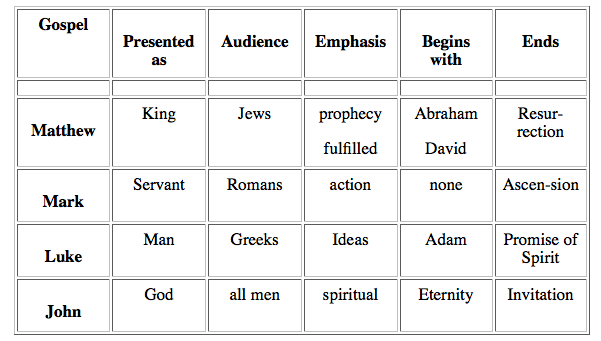
Whenever you begin to study the gospels, the question of why we have four gospels always arises. As John implies at the end of his gospel, no one book could contain all the things that Jesus did and said (John 21:25). That is the obvious answer. But we may advance three additional reasons for these four accounts.

First, they are a testimony to the accuracy of the records. With four separate accounts, we should expect 4 very different gospels with many contradictions and inaccuracies. This is even more true if, as the liberals purport, these gospels were merely the testimony of the church and not a historical account of Jesus. But instead of massive differences and contradictions, we find 4 records that, though different in style and selection, form a remarkably accurate record.

On the other hand, if the four writers wrote in collusion, we should expect their accounts to be identical. In such a case, 4 gospels that were the same should cause us to be suspect of the writers. Their differences indicate that they wrote independently yet paint the same basic picture of Jesus, His teachings and His deeds.

Matthew Henry reminds us that we do not count multiple witnesses in a court to be “tedious but necessary” to establish accuracy. Thus the four gospels do the same; they provide a multiple testimony to establish accuracy.

Second, the four provide a testimony to the completeness of the picture of Jesus. While we certainly cannot claim to have a record of all that Jesus taught and said (John 21:25), the four gospels provide us with a more complete picture of Jesus, His mission and His teachings than any one gospel could.

One might say that no one photograph would be enough. Would any parent be pleased to have only one photograph of his child? Or would that parent be satisfied in cutting up a variety of pictures of that child and pasting them together to form one? No. In the same way, we are blessed to have the four pictures instead of one composite.

Or consider the following. There have been many books written about Teddy Roosevelt. One deals with his private and domestic life. Another writes about his political life. A third focuses on his military career while a fourth deals with his life as sportsman. In every biography, we would find many common elements. Some events, all would include. But each author would include and exclude other events depending on how they fit with the purpose of the author.

In the same way, each of the gospels contains common accounts. But likewise, each provides accounts and perspectives that the others do not emphasize or include. Together, they give us a more complete picture of the life and teachings of Jesus.

Finally, the four gospels provide four portraits for different audiences. Matthew writes primarily for the Jews. Hence his gospel is full of references to fulfilled prophecies. Mark appeals to his Roman audience by his emphasis on action and servanthood. Luke writes to the Greeks and presents aspects of the life and teachings of Jesus that as the perfect man. John writes for all mean to present the spiritual aspects of the gospel.

Here is a chart that may help put the gospels in perspective.

Copyright Jim Ehrhard, 1999. You are permitted to reproduce and distribute this material in any format provided that: (1) you credit the author; (2) any modifications are clearly marked; (3) you do not charge a fee beyond the cost of reproduction; and (4) you do not make more than 100 copies without permission. If you would like to post this material to your web site or make any use other than as defined above, please contact Teaching Resources International

When we speak of the gospel, we usually think of it in two different ways. First, we use the word gospel to refer to a document that records the life of Jesus. Hence we have the four gospels: Matthew, Mark, Luke and John. Each one provides a record of the life and teachings of Jesus. Each is called a “gospel.”

Second, we also speak of the gospel as the message about Jesus that we must share and others are called to believe. The gospel message is summarized for us by the apostle Paul in I Corinthians 15:1-8. In short, the gospel is the message of redemption provided through the death and resurrection of Jesus Christ.

Both are accurate. The gospel is a message. But it is a message rooted and grounded in the historical reality of the life, teachings, death and resurrection of Jesus Christ. In opposition to neo-orthodoxy, evangelicals must say, “If the message is not true, then it is not worth believing.” Indeed, if the record about Jesus cannot be trusted, then, in the words of Paul, “our faith is in vain” and “we of all men are to be most pitied.” Here is one area where Christianity departs from all other religions: it must be based upon truth and based upon history.

Hence, the gospel is both a record to trust and a message to share. In this article, we will examine both aspects of the gospel as an introduction to our study of the Gospel of Mark.

The Gospel: A Record of His Life

Mark 1:1 begins, “The beginning of the gospel of Jesus Christ, the Son of God. As it is written….” Above all else, the gospel is about Jesus. It is the record of His life and teachings.

Mark begins his gospel with a connection to the Old Testament. Since he writes primarily for a Roman audience, he rarely uses the expression, “It is written.” But, in verse 2, he makes clear the connection between the coming of Jesus and the Old Testament. It is a connection that must not be neglected.

In the OT, we have the prophecy of His coming; in the NT, we have the history of His coming. The Old carries the expectation of hope; the New, the experience of reality. In Job 42, Job responds to God’s revelation, “I had heard of you by the ear, but now my eyes have seen.” The OT is the “hearing” of Messiah; the NT is the “seeing.” The gospel does not begin in the NT; it begins in the prophecies of the Old: “as it is written.”

Mark not only begins his gospel by tying it to the OT, he clearly states who Jesus is: “the Son of God.” More than anything else, the gospel is the record of who Jesus is. Here, Mark pulls no punches with his readers. Though this message is offensive to the Jews and foolish to the Romans, Mark knows that any gospel that does not proclaim who Jesus is is no gospel at all.

Throughout his gospel, Mark makes clear the reality of who Jesus is. One reading Mark’s gospel could not mistake Jesus for a mere man. Jesus calms the sea, casts out demons, raises the dead and walks on the water. Yet chapter 2 makes clear that this Jesus is God who alone can forgive sins. Such is the testimony of the gospel. It rests on who Jesus is. Mark boldly proclaims: “Jesus, the Son of God.”

The Gospel: A Message to Share (Mark 1:15)

The gospel is not merely a historical document; it is a message to share and believe. Jesus began His ministry with the emphasis on the gospel. “The kingdom of God is at hand. Repent and believe the gospel” was His message.

The gospel begins, not with good news, but with bad news. It first includes the command to repent. Many today would like to present the gospel without this element of repentance. But Jesus began His ministry with such a call. Matt. 4:17 indicates that it remained His message, “From that time, Jesus began to preach and say, ‘Repent….’” He even described the purpose of His coming as to “call sinners to repentance” (Luke 5:31). He told the multitudes, “Unless you repent, you will likewise perish” (Luke 13:3,5). He even commissioned His disciples saying, “that repentance … should be preached in His name….” (Luke 24:47).

The gospel is a call to repentance. It is a call to “change our minds” about ourselves and God. It is a call to fully acknowledge our sinfulness and desperate need for God. Ralph Kuiper puts it poignantly: “Only he who is oppressed by sin will realize his need of the Saviour. Only he who knows himself to be guilty and foul will run to Calvary for pardon and cleansing” (God Centered Evangelism, p. 153).

The gospel is also a call to “believe” or “put your complete trust in Christ and His atonement.” “The heart of the gospel…. is the glad tidings of what God in Christ has done for the salvation of sinners” (Kuiper, pp. 154-55). The gospel is not “do” but “done.” While all other religions focus on what must be done by the individual to merit salvation, Christianity focuses on what Jesus has done.

The gospel is the message that Jesus paid it all. It is not the message that Jesus died to make salvation possible; He died to purchase our salvation full and free. Our only response is to “repent and believe the gospel.”

One reality now faces us as we read the opening of Mark’s gospel. It is expressed in two phrases. First, Jesus notes: “the time is fulfilled.” In Galatians 4:4, Paul tells us: “in the fulness of time, God brought forth His Son born of a woman.” In Acts 17:30, Paul explains, “Truly, these times of ignorance God overlooked, but now commands all men everywhere to repent.” In short, Jesus is proclaiming that He is the fulfillment of the prophecies and that there no longer remains any excuse for waiting. Now God commands us to repent and believe the gospel. Second, Jesus points out “the Kingdom of God is at hand.” Again the message is clear: the time for waiting is over. Messiah has come. How will you respond?

By Jim Ehrhard

Copyright Jim Ehrhard, 1999. You are permitted to reproduce and distribute this material in any format provided that: (1) you credit the author; (2) any modifications are clearly marked; (3) you do not charge a fee beyond the cost of reproduction; and (4) you do not make more than 100 copies without permission. If you would like to post this material to your web site or make any use other than as defined above, please contact Teaching Resources International

A More Extensive Use of the Word by Jacob Spener

Thought should be given to the more extensive use of the Word of God among us. We know that by nature we have no good in us. If there is to be any good in us, it must be brought about by God. To this end the Word of God is the powerful means, since faith must be rekindled through the gospel, and the law provides the rules for good works and many wonderful impulses to attain them. The more at home the Word of God is among us, the more we shall bring about faith and its fruits.

It may appear that the Word of God has sufficiently free course among us inasmuch as at various places (as in this city [Frankfurt am Main]) there is daily or frequent preaching from the pulpit. When we reflect further on the matter, however, we shall find that with respect to this first proposal, more is needed. I do not at all disapprove of the preaching of sermons in which a Christian congregation is instructed by the reading and exposition of a certain text, for I myself do this. But I find that this is not enough. In the first place, we know that “all Scripture is inspired by God and profitable for teaching, for reproof, for correction, and for training in righteousness” (2 Timothy 3:16). Accordingly all Scripture, without exception, should be known by the congregation if we are all to receive the necessary benefit. If we put together all the passages of the Bible which in the course of many years are read to a congregation in one place, they will comprise only very small part of the Scriptures which have been given to us. The remainder is not heard by the congregation at all, or is heard only insofar as one or another verse is quoted or alluded to in sermons, without, however, offering any understanding of the entire context, which is nevertheless of the greatest importance. In the second place, the people have little opportunity to grasp the meaning of the Scripture except on the basis of those passages which may have been expounded to them, and even less do they have opportunity to become as practiced in them as edification requires. Meanwhile, although solitary reading of the Bible at home is in itself a splendid and praiseworthy thing, it does not accomplish enough for most people.

It should therefore be considered whether the church would not be well advised to introduce the people to Scripture in still other ways than through the customary sermons on the appointed lessons. This might be done, first of all, by diligent reading of the Holy Scriptures, especially of the New Testament. It would not be difficult for every housefather to keep a Bible or at least a New Testament handy and read from it every day or, if they cannot read to have somebody else read.

Then a second thing would be desirable in order to encourage people to read privately, namely, that where the practice can be introduced the books of the Bible be read one after another, at specified times in the public service, without further comment (unless one wished to add brief summaries). This would be intended for the edification of all, but especially of those that cannot read at all, or cannot read easily or well or of those who do not own a copy of the Bible.

For a third thing it would perhaps not be inexpedient (and I set this down for further and more mature reflection) to reintroduce the ancient and apostolic kind of church meetings. In addition our customary services with preaching, other assemblies would also be held in the manner in which Paul describes them in 1 Corinthians 14:26-40. One person would not rise to preach (although this practice would be continued at other times), but others who have been blessed with gifts and knowledge would also speak and present their pious opinions on the proposed subject to the judgment of the rest, doing all this in such a way as to avoid disorder and strife. This might conveniently be done by having several ministers (in places where a number of them live in a town) meet together or by having several members of a congregation who have a fair knowledge of God or desire to increase their knowledge me under the leadership of the Minister, take up the Holy Scriptures, read aloud from them, and fraternally discuss each verse in order to discover its simple meaning and whatever may be useful for the edification of all.  Anybody who is not satisfied with his understanding of a matter should be permitted to express his doubts and seek further explanation.  On the other hand, those (including the ministers) who have made more progress should be allowed the freedom to state how they understand each passage.  Then all that has been contributed, insofar as it accords with a sense of the Holy Spirit in the Scriptures, should be carefully considered by the rest, especially by the ordained ministers, and applied to the edification of the whole meeting.  Everything should be arranged with an eye to the glory of God, to the spiritual growth of the participants, and therefore also to their limitations.  Any threat of meddlesomeness, quarrelsomeness, self-seeking, or something else of this sort should be guarded against and tactfully cut off especially by the preachers who retain leadership in these meetings.

Not a little benefit is to be hope for from such an arrangement.  Preachers would learn to know the members of their own congregations and their weaknesses or growth in doctrine and piety, and a bond of confidence would be established between preachers and people which would serve the best interests of both.  At the same time, the people would have a splendid opportunity to exercise your diligence with respect to the word of God and modestly to answer their questions (which they do not always have the courage to discuss with their minister in private) and get answers to them.  In a short time, they would experience personal growth and would also be capable of giving better religious instruction to their children and servants at home.  In the absence of such exercises, sermons which are delivered in continually flowing speech are not always fully and adequately comprehended because there’s no time for reflection in between or because when one does stop reflect, much of what follows is missed (which does not happen in a discussion).  On the other hand, private reading the Bible, reading in the household, where nobody is present who may from time to time help point out the meaning and purpose of each verse, cannot provide the reader with sufficient explanation of all that he would like to know.  What is lacking in both of these instances (in public preaching and private reading) would be supplied by the proposed exercises.  It would not be a great burden either to the preachers or to the people, and much would be done to fulfill  the admonition of Paul in Colossians 3:16, “ let the Word of Christ dwell in you richly, as you teach in an honest one another in all wisdom, and as you sing psalms and hymns and spirituals songs.  “ In fact, such songs may be used in the proposed meetings for the praise of God and the inspiration of the participants.

This much is certain: The diligent use of the word of God, which consists not only a listening to sermons, but also reading, meditating, and discussing (Psalm 1:2 ), must be the chief means for reforming something, whether this occurs in the proposed fashion or in some other appropriate way.  The word of God remains the seed from which all that is good in us must grow.  If we succeed in getting the people to seek eagerly and diligently in the Book of life for their joy, their spiritual life will be wonderfully strengthened and they will become altogether different people….

One of the principal wrongs by which papal politics became entrenched, the people were kept in ignorance, and hence complete control of their consciences was maintained was that the papacy prohibited, and insofar as possible continues to prohibit, the reading of the Holy Scriptures.  On the other hand, it was one of the major purposes of the Reformation to restore to the people the Word of God which had lain a hidden under the bench (and this word was the most powerful means by which God blessed his work).  So this will be the principal means, now that the church must be put in better condition, whereby the aversion to scripture which many have may be overcome, neglect of the study be counteracted, and ardent zeal for it awakened.

From Jacob Spener, Pia Desideria, edited and translated by Theodore G. Tappert (Philadelphia: Fortress Press, 1964).

Piercing Preaching by C. H. Spurgeon

“Therefore let all the house of Israel know assuredly, that God hath made that same Jesus, whom ye have crucified, both Lord and Christ. Now when they heard this, they were pricked in their heart, and said unto Peter and to the rest of the apostles, Men and brethren, what shall we do?”-Acts 2:36, 37

This was the first public preaching of the gospel after our Lord was taken up into glory.  It was thus a very memorable sermon, a kind of first-fruits of the great harvest of gospel testimony.  It is very encouraging to those who are engaged in preaching that the first sermon should have been so successful.  Three thousand made up a grand take of fish at that first cast of the net.  We are serving a great and growing cause in the way chosen of God, and we hope in the future to see still larger results produced by that same undying and unchanging power which helped Peter to preach such a heart-piercing sermon.

Peter’s discourse was not distinguished by any special rhetorical display: he used not the words of man’s wisdom or eloquence.  It was not an oration, but it was a heart-moving argument, entreaty, and exhortation.  He gave his hearers a simple, well-reasoned, Scriptural discourse, sustained by the facts of experience; and every passage of it pointed to the Lord Jesus.  It was in these respects a model of what a sermon ought to be as to its contents.  His plea was personally addressed to the people who stood before him, and it had a practical and pressing relation to them and to their conduct.  It was aimed, not at the head, but at the heart.  Every word of it was directed to the conscience and the affections.  It was plain, practical, personal, and persuasive; and in this it was a model of what a sermon ought to be as to its aim and style.

Yet Peter could not have spoken otherwise under the impression of the divine Spirit: his speech was as the oracles of God, a true product of a divine inspiration. Under the circumstances, any other kind of address would have been sadly out of place.  A flashy, dazzling oration would have been a piece of horrible irreverence to the Holy Ghost; and Peter would have been guilty of the blood of souls if he had attempted it.  In sober earnestness, he kept to the plain facts of the case, setting them in the light of God’s Word; and then with all his might he pressed home the truth upon those for whose salvation he was laboring.  May it ever be the preacher’s one desire to win men to repentance towards God and faith in our Lord Jesus Christ!  May no minister wish to be admired, but may he long that his Lord and Master may be sought after! May none bewilder their people with the clouds of theoretic philosophy, but refresh them with the rain of revealed truth!  Oh, that we could so preach that our hearers should be at once pricked in their hearts, and so be led at once to believe in our Lord Jesus, and immediately to come forward and confess their faith in his name!

We must not forget, however, to trace the special success of the sermon on the day of Pentecost to the outpouring of the Holy Ghost in which Peter had shared.  This it is which is the making of the preacher.  Immersed into the Holy Spirit, the preacher will think rightly, and speak wisely; his word will be with power to those who hear.  We must not forget, also, that there had been a long season of earnest, united, believing prayer on the part of the whole church.  Peter was not alone: he was the voice of a praying company, and the believers had been with one accord in one place crying for a blessing; and thus not only was the Spirit resting upon the preacher, but on all who were with him.  What a difference this makes to a preacher of the gospel, when all his comrades are as much anointed of the Spirit as himself!  His power is enhanced a hundred-fold.  We shall seldom see the very greatest wonders wrought when the preacher stands by himself; but when Peter is described as standing up “with the eleven,” then is there a twelve-man ministry concentrated in one; and when the inner circle is further sustained by a company of men and women who have entered into the same truth and are of one heart and one soul, then is the power increased beyond measure.  A lonely ministry may sometimes affect great things, as Jonah did in Nineveh; but if we look for the greatest and most desirable result of all, it must come from one who is not alone, but is the mouthpiece of many.  Peter had the one hundred and twenty registered brethren for a loving bodyguard, and this tended to make him strong for his Lord.  How greatly I value the loving co-operation of the friends around me!  I have no words to express my gratitude to God for the army of true men and women who surround me with their love, and support me with their faith.  I pray you never cease to sustain me by your prayers, your sympathy, and your co-operation, until some other preacher shall take my place when increasing years shall warn me to stand aside.

Yet much responsibility must rest with the preacher himself; and there was much about Peter’s own self that is well worthy of imitation.  The sermon was born of the occasion, and it used the event of the hour as God intended it to be used.  It was earnest without a trace of passion, and prudent without a suspicion of fear.  The preacher himself was self-collected, calm, courteous, and gentle.  He aired no theories, but went on firm ground, stepping from fact to fact, from Scripture to Scripture, from plain truth to plain truth.  He was patient at the beginning, argumentative all along, and conclusive at the end.  He fought his way through the doubts and prejudices of his hearers; and when he came to the end, he stated the inevitable conclusion with clearness and certainty.  All along he spoke very boldly, without mincing the truth – “Ye with wicked hands have crucified and slain him whom God has highly exalted.”  He boldly accused them of the murder of the Lord of glory, doing his duty in the sight of God, and for the good of their souls, with great firmness and fearlessness.  Yet there is great tenderness in his discourse.  Impulsive and hot-headed Peter, who, a little while before, had drawn his sword to fight for his Lord, does not, in this instance, use a harsh word; but speaks with great gentleness and meekness of spirit, using words and terms all through the address which indicate a desire to conciliate, and then to convince.  Though he was as faithful as an Elijah, yet he used terms so courteous and kindly that, if men took offense, it would not be because of any offensiveness of tone on the speaker’s part.

Peter was gentle in his manner, but forceful in his matter.  This art he had learned from his Lord; and we shall never have master-preachers among us till we see men who have been with Jesus, and have learned of him.  Oh, that we could become partakers of our Lord’s spirit and echoes of his tone!  Then may we hope to attain to Pentecostal results, when we have preachers like Peter, surrounded by a band of earnest witnesses and all baptized with the Holy Ghost and with fire.

When we follow the run of Peter’s argument, we do not wonder that his hearers were pricked in their hearts. We ascribe that deep compunction to the Spirit of God; and yet it was a very reasonable thing that it should be so.  When it was clearly shown to them that they had really crucified the Messiah, the great hope of their nation, it was not wonderful that they should be smitten with horror.  Looking as they were for Israel’s King and finding that he had been among them, and they had despitefully used him, and crucified him, they might well be smitten at the heart.  Though for the result of our ministry we depend wholly upon the Spirit of God, yet we must adapt our discourse to the end we aim at; or, say rather, we must leave ourselves in the Spirit’s hand as to the sermon itself as well as in reference to the result of the sermon.  The Holy Ghost uses means which are adapted to the end designed.  Because, beloved, I do desire beyond all things that many in this congregation may be pricked in the heart, I have taken this concluding part of Peter’s discourse to be the text of my sermon this morning.  Yet my trust is not in the Word itself, but in the quickening Spirit who works by it.  May the Spirit of God use the rapier of his Word to pierce the hearts of my hearers!