Feeds:
Posts
Comments

Posts Tagged ‘christianity’

Inspiration … (August2026 Update) 

Times of war and crises require all kinds of heroes. But probably one of the most important heroes is not one that we usually think of. We quickly think about the outnumbered soldiers capturing a company of enemy soldiers by themselves. Or we remember the medic who crawls across enemy lines to rescue injured soldiers. But perhaps the most important hero in war often never directly sees combat. This is the leader who inspires the soldiers to fight and motivates the people to hang on in spite of relentless enemy attacks. 

Winston Churchill did this in the Second World War. Against all odds and relentless attacks by Germany, Churchill’s speeches were encouraged both the population and the army to keep on fighting no matter how dim the situation seemed. Some might say that Volodymyr Zelenskyy has done the same for Ukraine over the last 4+ years. When Russia invaded and surrounded Kyiv in early 2022, President Biden offered to evacuate Zelensky from Kyiv. Zelensky replied, “I need ammunition, not a ride.” With that and many other selfless words, Zelensky has inspired the Ukrainian people to fight on against a larger and superior power. 

But that’s not what the Bible means by inspiration. The dictionary definitions for inspiration are a lot like Churchill and Zelensky’s inspiring their nations.  So, the most common meaning for inspiration is to be motivated by someone or something. Another definition for inspiration is to get a sudden creative idea. It’s a lot like the cartoons where someone is thinking about something and, all of the sudden, a light bulb comes on in their mind.  They got an inspiration – a sudden creative idea. 

However, the biblical or theological definition is totally different. The biblical idea of inspiration comes primarily from 2 Timothy 3:16 where Paul says that all scripture is inspired by God. And the word he uses for “inspired” is a unique word – Theopneustos – that literally means God-breathed. So, the biblical idea of inspiration is very different from the dictionary definition.  It is not simply an inspiration that a person gets, but rather it is God breathing His words into the authors of scripture. So, we would define inspiration as the process of recording God’s revelation in writing. Let’s look at a number of aspects about this definition so that we can better understand what inspiration means in biblical and theological sense. 

(more…)

Read Full Post »

The God of the Gospel … (April 2026 Update) 

Goodness and greatness rarely go together. Often when a person becomes great, they cease to be good. Their desire for power and recognition often eclipse their desire for good. Many great rulers often started with a desire to do good for their countries and their people. But, when greatness comes, they seek even more greatness and more power. This is why Lord Acton famously said, “Power tends to corrupt, and absolute power corrupts absolutely.” Only God is totally great and totally good.  

But it is important to know that a person’s view of God affects the way they live their lives. Some people view God as a “cosmic grandfather” who lovingly overlooks sin that we commit. Others see God as a “cosmic kill-joy” who is always looking down from heaven, seeing us enjoying anything in life and shouting at us to stop it!  

(more…)

Read Full Post »

The Power of the Gospel … (March 2026 Update) 

In 1844, the world was dramatically changed by one message. On May 24, 1844, Samuel Morris sent a message from Washington DC to his partner in Baltimore, Maryland (a distance of just 40 miles). The message, “What hath God wrought [accomplished],” expressed the arrival of an almost miraculous new technology.   

Before the development of the telegraph, information in the 19th century was transmitted across long distances by drumbeats, signal fires, smoke signals, or flags to exchange information between far-flung points. By the early 19th century, it was common knowledge that information could only travel as fast as the fastest horse (or horses, in the case of the Pony Express). The Pony Express made it possible to send a letter from St. Joseph Missouri to Sacramento, California in just 10 days! For example, the greatest American victory in the War of 1812 took place 2 weeks after the end of the war and the signing of the peace treaty. Why? Because information travelled so slowly, neither the British troops nor the American forces knew that the war had ended. With the invention of the telegraph, messages that previously took weeks were delivered in minutes, establishing the first “real-time” information network. This invention truly turned the world upside down in those days! 

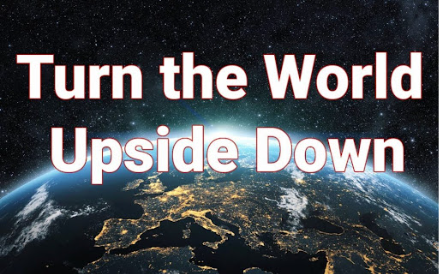
But long before the invention of the telegraph, another revolutionary idea swept across the Roman Empire in the 1st century. In Acts 17:6, the people of Thessalonica were confronted by the spread of the gospel and sought to stop it. They cried, “These men who have turned the world upside down have come here also….”  

That’s quite interesting, isn’t it? A couple of insignificant preachers came to this major city of Thessalonica in the Roman Empire, and they were accused of upsetting the entire world! And it wasn’t just Paul and Silas – this same gospel that they were preaching was being rapidly spread across the Roman Empire by believers at an astonishing rate. And the message they were proclaiming was changing people everywhere. They were truly “turning the world upside down!” 

(more…)

Read Full Post »

Good Theology … (February 2026 Update) 

Mention theology or doctrine among Christians and you are likely to get a variety of responses – mostly negative.  But theology is simply “the study of God.”  In that sense, everyone is a theologian, even the atheist!  The question is not whether we have a theology, but whether our theology is good or bad, and whether our theology is biblical or not! 

In Mere Christianity, C. S. Lewis says, “[If] you do not listen to Theology, that will not mean that you have no ideas about God. It will mean that you have a lot of wrong ones— bad, muddled, out-of-date ideas.” That’s why the study of theology is so important. 

(more…)

Read Full Post »

Unless They Are Sent … (January 2026 Update) 

On July 20, 1969, Neil Armstrong became the first man to walk on the moon. “Buzz” Aldrin, who travelled to the surface of the moon with Armstrong, was the second. Michael Collins piloted the Command Module orbiting above the moon. They were sent to the moon by NASA. But behind these three men were over 400,000 senders! We remember the 3 men who went to the moon but often forget that they would never have made it to the moon without the unknown senders behind them! 

That’s a perfect picture of missions. We are right to put much of our focus on the missionaries who leave jobs and families to travel to foreign countries, to learn a language and establish a church. They are truly heroes in every sense of the word. But we often forget that not one of them could go without senders – people who partner with them and support them so that they can go and share the gospel. This is what Paul is talking about in Romans 10:14-15: “How are they to call on one they have not believed in? And how are they to believe in one they have not heard of? And how are they to hear without someone preaching to them? And how are they to preach unless they are sent? As it is written: ‘How beautiful are the feet of those who bring good news!’”  

(more…)

Read Full Post »

Older Posts »